The Golden Month: A 26-Day Postpartum Recovery Guide
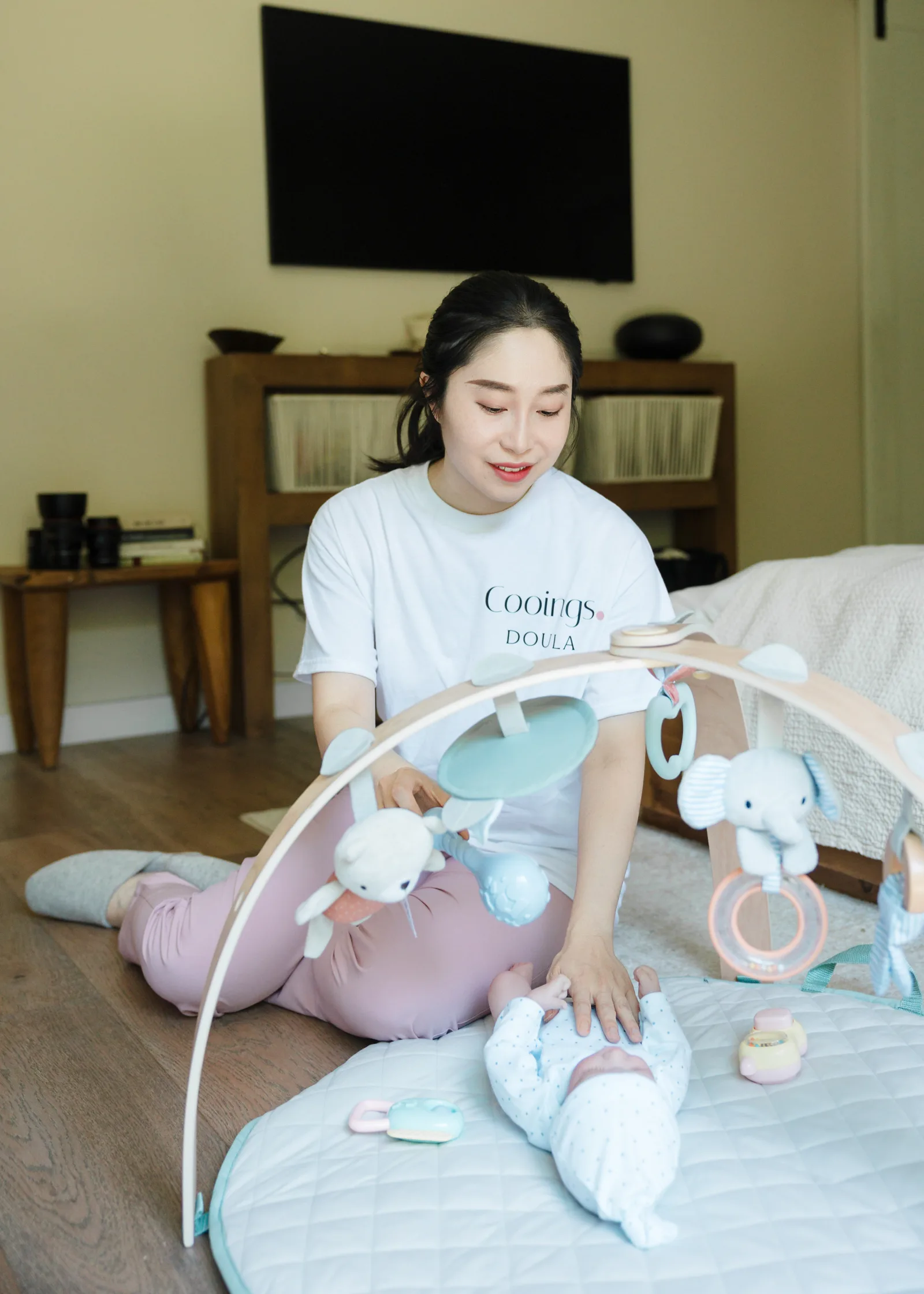
Your mother, or your mother-in-law, may already have a plan for your month. Your OB has a different one. If you are an Asian-American birthing parent, the exhausting part is that both may be partly right.
I am Mia, an International Board Certified Lactation Consultant (IBCLC) and the founder of Cooings. In our work with postpartum families, this tension comes up constantly: a parent trying to heal, feed a newborn, respect an elder, and also follow current medical advice, often on almost no sleep. This guide is for that exact kitchen-table conversation.
The frame here is 坐月子 (zuò yuè zi), the Chinese tradition of "sitting the month," because that is the version many Cooings families are actively living through at home. The same recovery logic shows up in Korean 산후조리 (sanhujori), Vietnamese ở cữ, and Filipino postpartum confinement: extended rest, family help, warm food, fewer visitors, and the belief that the first weeks matter[1]. The tradition is not the problem. Some of the rules need updating. The bones are good.
What is the golden month?
The golden month — 坐月子 (zuò yuè zi) in Chinese, 산후조리 (sanhujori) in Korean, ở cữ in Vietnamese — is the traditional postpartum confinement period of roughly 26 to 40 days after birth, built around rest, warmth, dense nourishment, and live-in help while the body recovers[1]. The classical Chinese version runs 30 days; some Cantonese families keep 40; at Cooings we structure it as 26 days, which is where our 26-day live-in program gets its shape. The tradition's core claim — that the first weeks after birth deserve protected, supported recovery — is one modern obstetrics now agrees with.
What yuè zi is really protecting
坐月子 goes back roughly two thousand years in the Chinese medical canon. The classical idea is that childbirth depletes 气 (qì) and 血 (xuè), leaving the postpartum body vulnerable to "wind" and "cold" while it rebuilds[2]. The traditional period is 30 days, though families vary. Some Cantonese households stretch it to 40. Some Northern families use 26 or 28. At Cooings, we use a 26-day structure because it captures the handoff from acute recovery into a more sustainable rhythm with the baby.
Most versions of yuè zi circle around the same pillars: warmth, rest, dense nourishment, limited physical activity, limits on bathing or water exposure, and live-in household help. The details change by region and language. Korean sanhujori emphasizes warmth, seaweed soup (미역국), and often a stay at a 산후조리원, or postpartum care center, for one to two weeks before going home[3]. Vietnamese ở cữ guards against gió, or wind, for thirty to one hundred days, with warm foods and herbal preparations[1]. Filipino postpartum traditions often keep the mother indoors for thirty to forty days with family-prepared food and warmth[1].
It helps to understand why elders can feel so firm about these rules. In the traditional model, the postpartum body is temporarily open: joints are loose, qi is depleted, meridians are vulnerable. A cold drink now may be blamed for weak digestion later. Wet hair now may be blamed for headaches or joint pain decades from now. You may not accept that physiology, but the practical effect is powerful: the family treats recovery as serious.
That is something mainstream American postpartum culture often fails to do. Too many parents are given a six-week appointment and a vague sense that they should be "back to normal" soon. Yuè zi, at its best, refuses that. It says: stay in bed, eat, be cared for, do not perform competence before your body is ready.
When you look at the medical literature, the protective intent holds up well. Protect rest. Protect nourishment. Protect the feeding relationship. Protect the new parent from being left alone too soon. The spirit is strong. The specific rules need editing.
Where evidence and elders agree
The American College of Obstetricians and Gynecologists (ACOG) describes postpartum recovery as the "fourth trimester" and recommends ongoing contact after birth, not one isolated six-week visit. ACOG calls for contact within three weeks and a more complete visit by twelve weeks[4]. The World Health Organization (WHO) recommends at least three postnatal checkpoints in the first six weeks: 48–72 hours, 7–14 days, and around week six. WHO also names partner involvement, mental-health screening, and feeding support as part of a positive postnatal experience[5].
Read those guidelines next to yuè zi and the overlap is hard to miss.
Rest is not indulgent. ACOG names sleep deprivation, fatigue, and pain as central challenges in the fourth trimester, and treats protected recovery time as part of postpartum care[4]. Yuè zi has always understood this. A parent in the first week after birth should not be hosting guests, cooking dinner, and proving that they are fine.
Dense food matters. WHO guidance on postpartum nutrition emphasizes protein, energy-dense foods, and iron-rich intake, especially because postpartum anemia is common and can affect energy, cognition, and mood[6]. Bone broths, eggs, organ meats, sesame oil chicken, and Korean seaweed soup are not random comfort foods. They are traditional ways of getting warmth, protein, minerals, and calories into a body that is healing and, often, making milk.
Help protects mental health. A 2023 PLOS ONE systematic review on Chinese confinement practices and postpartum depression found mixed results overall, but the social-support part of confinement stood out. Live-in family help, hired caregiving, and protected first weeks were associated with lower depression risk[7]. The key distinction is support versus control. Being cared for is not the same as being managed.
Quiet supports feeding and bonding. ACOG and WHO both emphasize feeding support and skin-to-skin contact in the early weeks[4][5]. Yuè zi creates the right conditions when it is done well: fewer visitors, less noise, food arriving without the parent planning it, and an experienced adult nearby. Cluster feeding around days 3–5 is much easier when no one expects you to fold laundry.
Mental health screening now belongs inside the month. This is where modern care adds something essential. ACOG and WHO both include screening for postpartum depression and anxiety across the early postpartum period, not only at the six-week visit[4][5]. Traditional yuè zi did not have a clinical screening tool, but it did understand that a new parent should not be left alone too much, too soon. The modern version keeps the support and adds a referral pathway.
If your mother says, "Rest, eat, do not lift things, let me cook," she is not far from the OB's advice. The fight is usually over the footnotes.
The rules I would update
This is the section that can get families upset, so I want to be precise. I am not treating Western medicine as a more advanced replacement for Asian tradition. That framing has done harm in immigrant medical care[8]. Instead, I am naming rules where current evidence does not support the old prohibition, then offering a modern translation that keeps the protective intent.
Bathing restrictions
The traditional rule: no showers, no hair washing, sometimes no tooth brushing for the full month. The likely original reason was practical. In a home without central heating, clean running water, or a hair dryer, getting wet could mean staying cold for hours. For a bleeding, depleted, newly postpartum body, that was not a small concern.
Modern obstetric guidance is different. Showers are generally safe once the birthing parent can stand steadily, often within hours after a vaginal birth and around 24 hours after a cesarean when the dressing situation allows[9]. Full immersion is another matter. Tub baths and swimming are usually delayed until lochia has resolved or a cesarean incision has fully closed, often three to six weeks, because the cervix or incision is still healing and infection risk matters[9]. Sitz baths are different again. A shallow warm soak for the perineum is commonly used for healing in the first days postpartum[9].
The modern translation: take warm showers. Wash your hair if you want to. Dry it fully, keep the bathroom warm, and skip the tub or pool until your provider clears you.
Cold-water and cold-food rules
The traditional rule: no cold drinks, no raw vegetables, no fruit straight from the refrigerator, no cold air on bare skin. In traditional Chinese medicine terms, the postpartum body is often described as 虚寒, depleted and cold, and cold input is thought to deepen that state. There is also a practical layer. In a world without refrigeration, warm or room-temperature drinks were normal, and warm broth really can feel better on a tired body than ice water.
Modern evidence does not support a strict ban on cold. A healthy postpartum parent does not need to avoid cool water, fruit, or an air-conditioned room. What does matter is hydration, especially when breastfeeding. Warm fluids can be soothing during feeds, and many lactating parents find broth easier to sip consistently than plain water. That does not make cold dangerous. It makes warm convenient and comforting.
The modern translation: drink what you will actually drink. Choose warm if it helps. Do not stay thirsty because someone gave you water with ice.
Brushing teeth and oral hygiene
Some yuè zi rules extend the cold-water concern to tooth brushing. The worry is that water on the gums during a depleted state may weaken the teeth permanently. Again, the older context matters. If warm running water was not available at the sink, skipping brushing may have felt simpler than arranging warm water every time.
Current dental and obstetric guidance does not support skipping oral hygiene for a month. Pregnancy and early postpartum are associated with higher rates of gingivitis and dental caries, and not brushing increases that risk. A reasonable compromise is simple: use a soft toothbrush and warm water. Brush gently. Do not abandon your mouth for 30 days.
Total confinement and "no leaving the house"
The traditional rule: do not leave the house for the full month, do not see outside visitors, do not sit near an open window. The original logic was protective. Before vaccines and antibiotics, limiting exposure protected a healing parent and a newborn in a vulnerable period. That instinct is still worth respecting.
What needs updating is the rigidity. Studies of postpartum depression in Chinese populations have found that very strict confinement, especially when a parent feels trapped, watched, or unable to make choices about their own body, is associated with higher depression scores. At the same time, social support can remain protective[7]. That difference matters. Support helps. Isolation can harm.
The modern translation: limit visitors, especially anyone sick. Protect the newborn from unnecessary exposure. But if your body allows it, step outside for ten minutes of sunlight, sit on the porch, or take a slow walk around the block by week two. The goal is not "never see the sun." The goal is "do not run yourself into the ground."
Tradition vs. Evidence — Quick Reference
| Traditional rule | Modern evidence says | What I tell clients |
|---|---|---|
| No showers or hair washing | Showers are safe within hours of vaginal birth; ~24h after C-section | Warm showers fine, dry hair fully, keep bathroom warm |
| No tub bath / no swimming | Defer until lochia resolves or incision heals (3–6 weeks) | This one stays — wait for OB clearance |
| No cold drinks or cold food | No clinical evidence cold input is harmful | Drink what is comfortable; warm fluids help feeding comfort |
| No leaving the house for 30 days | Strict isolation increases depression risk | Limit sick visitors; step outside for sun by week two |
| Eat warm, dense, protein-rich food | Strongly supported for tissue repair + lactation | Keep this. The elders are right. |
| Live-in family or hired help | Strongly supported; reduces depression risk | Keep this. The elders are right. |
| Protect rest, do not lift heavy things | Strongly supported by ACOG and WHO | Keep this. The elders are right. |
A 26-day rhythm that honors both
This is the structure I use with many Cooings families. It is not a prescription. Your birth, your bleeding, your incision, your blood pressure, your mood, and your baby's feeding all matter, and your clinician's advice comes first. Think of this as a scaffold for the month, not a rulebook.
Week 1 (Days 1–7) — Acute recovery + feeding establishment
This is the week of the most visible repair. Lochia is usually heaviest at first, with lochia rubra, the bright-red stage, often days 1–4[10]. Milk commonly transitions from colostrum toward mature supply around days 3–5. Your main job is not productivity. It is rest, feeding access, hydration, food, and watching your body closely.
Keep the daily plan small: feed every 2–3 hours, including overnight, unless your pediatric team gives different instructions. Sip fluids often. Eat protein- and iron-rich meals every few hours. Do not lift more than the baby. Walk to the bathroom. Walk to the kitchen if you want to. That is enough. Pay attention to lochia color and how quickly pads are soaking. Use skin-to-skin when it feels good.
An experienced caregiver this week should be doing the unglamorous work: cooking, dishes, laundry, visitor management, holding the baby between feeds so you can sleep, helping you get pillows in the right place for latch, and noticing bleeding changes without making you feel watched.
Week 2 (Days 8–14) — Stabilizing supply, finding rhythm
Lochia is often shifting toward lochia serosa, lighter and pink-brown[10]. Milk supply is beginning to respond to the baby's actual demand. Some energy may return, then disappear again by dinner. That unevenness is normal. This is also a window when postpartum mood disorders commonly show themselves, which is why both WHO and ACOG recommend mental-health screening in the early postpartum period[4][5].
Keep protecting rest, but allow short stretches upright if they feel good. Step outside for ten minutes of sunlight if the weather and your body allow. Begin gentle pelvic floor awareness, not formal exercise. Keep eating protein- and iron-rich foods. Schedule or attend your early postpartum contact, since ACOG calls for contact within 3 weeks and WHO suggests a 7–14 day check[4][5]. If breastfeeding hurts, milk transfer seems low, or feeds are taking over your entire day, call an IBCLC now. Do not wait until you are desperate.
Watch for sadness that does not lift, intrusive thoughts, rage that scares you, or being unable to sleep even when the baby is sleeping. These symptoms deserve care. Tell your provider.
Week 3 (Days 15–21) — Re-entering the world, slowly
Lochia may be moving toward lochia alba, the pale yellow-white stage[10]. Many parents feel more like themselves this week, but only in pockets. This is the week when people overdo it because they finally can.
Choose one or two small returns to the world. A slow walk around the block. A full shower with hair washing if you have been postponing it. One brief outing if it feels restorative, not performative. Keep rest as the default during the baby's sleep or calm windows. If you have not had postpartum contact yet, prioritize it. Ask your provider about your return-to-exercise timeline, since formal exercise often waits until around six weeks after vaginal birth and longer after cesarean[4].
A good caregiver starts handing back small tasks this week so the end of support is not a cliff. They may still cover food, laundry, or a stretch of night support, but the household should begin practicing the next rhythm.
Week 4 (Days 22–26) — Closing the month
By this point, lochia may be winding down or already resolved, though variation up to six weeks can still be normal[10]. Many Chinese families mark the close of yuè zi with something small: a special meal, a haircut, the first formal outing. Even if you do not keep the ritual, the transition is real. You are leaving acute recovery and entering the rest of the fourth trimester.
Use these days to check the supports around you. Confirm your comprehensive postpartum visit is scheduled. Keep iron-rich foods in the rotation, since ACOG and WHO note iron stores can remain depleted for months postpartum, especially after significant blood loss[6]. Keep feeding support available. Milk supply is still responsive and still changing. Decide who does what when the live-in caregiver leaves, what your partner can realistically cover, and what mental-health resources you can access if the next month is harder than expected.
The end of yuè zi is not the end of recovery. It is the end of one layer of protection. Replace it thoughtfully.
Handling family pressure without burning the bridge
Most yuè zi advice articles skip the hardest part: you may not be the only person making decisions. Your mother flew in from Shanghai. Your mother-in-law has already stocked the freezer. Your partner is trying to keep peace between the person who raised him and the person who just gave birth. In many families, the evidence-based answer is the easy part. The relationship part is harder.
A few patterns help.
Give the elder a real domain. Your mother may know the confinement kitchen better than your OB ever will. Let her own the food if the food is safe and nourishing. Let your clinician own the medical boundaries. Clear territories reduce conflict.
Translate instead of contradicting. "The doctor said warm showers are safe now because bathrooms are heated" lands very differently from "that rule is wrong." It is also more accurate. Many rules were built for different living conditions.
Use the right messenger. If the matriarch is from your partner's side, your partner should deliver the harder messages. If she is your mother, you may need to. This is not avoidance. It is relationship preservation.
Name the shared goal. No grandmother wants the birthing parent miserable, isolated, or sick. "The doctor wants me to get ten minutes of sunlight so my mood stays stable and I can care for the baby" is usually easier to hear than "I need freedom."
[Cooings practice] One client's mother held a strict no-bathing line for two weeks. The compromise became a "covered shower": a quick warm rinse, bathroom heated, towel warmed and ready, hair dried immediately. No one got everything they wanted. The parent got clean. The grandmother felt the cold had been respected. That is often what a good yuè zi compromise looks like.
[Cooings practice] Another client, an attorney in the Bay Area, felt guilty every time she looked at her phone in bed because her mother said screens "use up the eyes" during yuè zi. Her partner helped negotiate a middle ground: thirty minutes after feeds was fine; endless scrolling at 2 a.m. was not. Her mother was not entirely wrong about the instinct. Close-focus work can feel tiring after birth, and screens can disrupt sleep. The problem was the absolute ban. Once they named the thing the rule was trying to protect, they could adjust the rule.
The goal is not to defeat the elder. It is also not to obey silently and resent everyone. The better question is: what is this rule trying to protect? Warmth? Rest? Milk supply? Mental steadiness? Once the protective purpose is clear, most families can find a version that works in a heated apartment, with a pediatrician, an OB, an IBCLC, and a very real need for peace in the home.
- What is the golden month after giving birth?
- It is the traditional Asian postpartum confinement period — 坐月子 (zuò yuè zi) in Chinese, sanhujori in Korean, ở cữ in Vietnamese — of roughly 26 to 40 days of protected rest, warm dense food, limited visitors, and live-in help. The protective intent matches what ACOG and WHO now call fourth-trimester care; some individual rules need updating for modern homes.
- How long is postpartum confinement?
- The classical Chinese version is 30 days. Some Cantonese families extend to 40, some Northern families use 26 or 28, and Korean sanhujori often includes a one-to-two-week stay at a postpartum care center. Cooings structures the month as 26 days, covering the handoff from acute recovery into a sustainable rhythm with the baby.
- Can I shower during the confinement month?
- Yes. Warm showers are generally safe within hours of a vaginal birth and around 24 hours after a cesarean — keep the bathroom warm and dry your hair fully. What should wait is full immersion: tub baths, hot tubs, and pools are usually deferred three to six weeks until lochia resolves or the incision heals, with your provider making the final call.
- Do I really have to avoid cold water and cold food?
- There is no clinical evidence that cold drinks or food harm postpartum recovery. What matters is staying hydrated, especially while breastfeeding. Warm fluids are comforting during feeds and easier for many parents to sip consistently — choose warm because it helps, not because cold is dangerous.
- Does confinement help prevent postpartum depression?
- The evidence is mixed on confinement overall, but one component stands out: social support. Live-in family help, hired caregiving, and protected first weeks are associated with lower depression risk, while very strict isolation — feeling trapped or controlled — is associated with higher depression scores. Keep the support, drop the rigidity.
[1] Postpartum confinement traditions across Asia. (2025). Comparative summary, drawn from peer-reviewed and ethnographic literature on Chinese, Korean, Vietnamese, and Filipino postpartum practice. Retrieved April 2026 from https://en.wikipedia.org/wiki/Postpartum_confinement [2] Pillsbury, B. L. K. (1978). "Doing the Month": Confinement and convalescence of Chinese women after childbirth. Social Science & Medicine, 12. Retrieved April 2026 from https://embryo.asu.edu/items/173357 [3] Sanhujori (Korean postpartum care). (2025). Wikipedia summary referencing peer-reviewed Korean public-health literature on sanhujoriwon care. Retrieved April 2026 from https://en.wikipedia.org/wiki/Sanhujori [4] American College of Obstetricians and Gynecologists. (2018, reaffirmed). ACOG Committee Opinion No. 736: Optimizing Postpartum Care. Obstetrics & Gynecology. Retrieved April 2026 from https://www.acog.org/clinical/clinical-guidance/committee-opinion/articles/2018/05/optimizing-postpartum-care [5] World Health Organization. (2022). WHO recommendations on maternal and newborn care for a positive postnatal experience. Retrieved April 2026 from https://www.who.int/publications/i/item/9789240045989 [6] American College of Obstetricians and Gynecologists. (2021). ACOG Practice Bulletin No. 233: Anemia in Pregnancy. Retrieved April 2026 from https://pubmed.ncbi.nlm.nih.gov/34293770/ [7] Wong, J. & Fisher, J. (2023). Maternal postnatal confinement practices and postpartum depression in Chinese populations: A systematic review. PLOS ONE. Retrieved April 2026 from https://journals.plos.org/plosone/article?id=10.1371/journal.pone.0293667 [8] Liu, N. et al. (2014). The role of traditional confinement practices in determining postpartum depression in women in Chinese cultures: A systematic review. Retrieved April 2026 from https://pubmed.ncbi.nlm.nih.gov/19200625/ [9] Cleveland Clinic. (2024). Lochia (postpartum bleeding) and postpartum hygiene guidance. Retrieved April 2026 from https://my.clevelandclinic.org/health/body/22485-lochia [10] Cleveland Clinic. (2024). Lochia: Stages, duration, and warning signs. Retrieved April 2026 from https://my.clevelandclinic.org/health/body/22485-lochia [11] Centers for Disease Control and Prevention. (2024). Hear Her Campaign: Urgent Maternal Warning Signs and Symptoms. Retrieved April 2026 from https://www.cdc.gov/hearher/maternal-warning-signs/index.html
The First 72 Hours of Breastfeeding: An IBCLC's Playbook
Hour-by-hour what's normal, what to flag, and when to call. An International Board Certified Lactation Consultant walks you through the first three days at the breast.
C-Section Recovery, Week by Week
A practical week-by-week timeline for recovering from a cesarean: pain control, incision care, mobility limits, breastfeeding positions that spare the scar, and the warning signs that mean call your OB tonight.
Postpartum Depression: Signs to Watch & When to Seek Help
You're 8 days postpartum and you've cried for an hour over a sock. Here is how clinicians distinguish baby blues from a perinatal mood disorder, and exactly how to start the conversation with your provider.
The First 72 Hours of Breastfeeding: An IBCLC's Playbook
Hour-by-hour what's normal, what to flag, and when to call. An International Board Certified Lactation Consultant walks you through the first three days at the breast.
C-Section Recovery, Week by Week
A practical week-by-week timeline for recovering from a cesarean: pain control, incision care, mobility limits, breastfeeding positions that spare the scar, and the warning signs that mean call your OB tonight.
Postpartum Depression: Signs to Watch & When to Seek Help
You're 8 days postpartum and you've cried for an hour over a sock. Here is how clinicians distinguish baby blues from a perinatal mood disorder, and exactly how to start the conversation with your provider.
Mia Lau
Mia is the founder of Cooings and an International Board Certified Lactation Consultant. She leads the company's clinical standards and writes on insurance navigation, breastfeeding, and the systems that connect AAPI families to professional postpartum care.